Linux下c语言进程通讯——wait()/wait(&status)/WIFEXITED(status)和exit()之间的关系
2
2021-11-02
wait()函数定义
#include <sys/types.h>
#include <sys/wait.h>
pid_t wait(int *status)
// 参数status用来保存被收集进程退出时的一些状态,它是一个指向int类型的指针。但如果我们对这个子进程是如何死掉的毫不在意,只想把这个僵尸进程消灭掉,(事实上绝大多数情况下,我们都会这样想),我们就可以设定这个参数为NULL,如pid=wait(NULL),返回给pid的值就是子进程的id
WIFEXITED(status)/WEXITSTATUS(status)
当子进程正常结束时,WIFEXITED(status) 返回非0值;当子进程异常结束时,WIFEXITED(status) 返回0值
WEXITSTATUS(status)在WIFEXITED(status)为非0时可以用来获取exit()中的参数即返回给父进程的值,如果子进程调用exit(5)退出,WEXITSTATUS(status)就会返回5;如果进程不是正常退出的,也就是说,WIFEXITED返回0
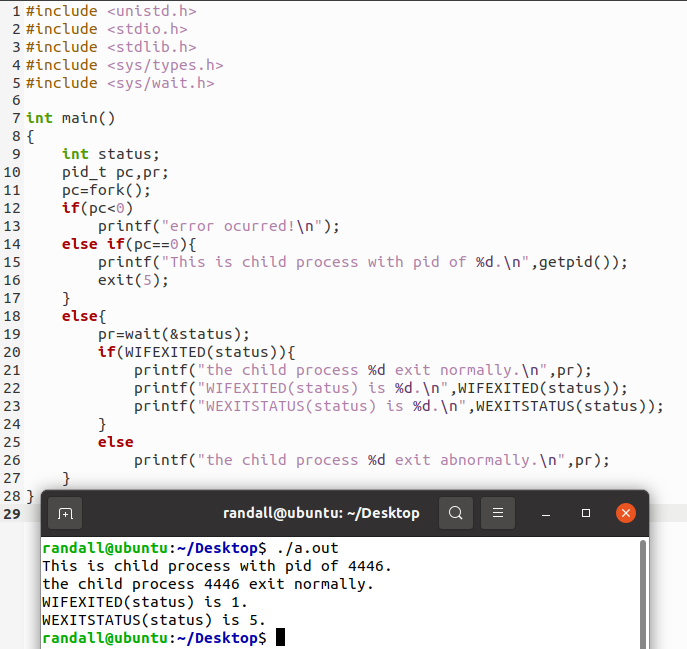
代码
#include <unistd.h>
#include <stdio.h>
#include <stdlib.h>
#include <sys/types.h>
#include <sys/wait.h>

int main()
{
    int status;
    pid_t pc,pr;
    pc=fork();
    if(pc<0)
        printf("error ocurred!\n");
    else if(pc==0){
        printf("This is child process with pid of %d.\n",getpid());
        exit(5);
    }
    else{
        pr=wait(&status);
        if(WIFEXITED(status)){
            printf("the child process %d exit normally.\n",pr);
            printf("WIFEXITED(status) is %d.\n",WIFEXITED(status));
            printf("WEXITSTATUS(status) is %d.\n",WEXITSTATUS(status));
        }
        else
            printf("the child process %d exit abnormally.\n",pr);
    }
}